Nighttime Anxiety in Perimenopause: Why You Wake Afraid
Edited & Reviewed by Kira Hensley, M.A., M.Ed., Registered Psychotherapist ~ Women's Mental Health, Anxiety & Perimenopause
Updated March 2026. 7 min read
TL;DR Waking at night with a pounding heart or a mind full of worries is one of the most distressing — and least talked about — experiences of perimenopause. It is not a sign that something is catastrophically wrong. Hormonal shifts, cortisol surges, and your nervous system are all playing a role, and there are specific, evidence-based approaches through integrative therapy that genuinely help both experiences.
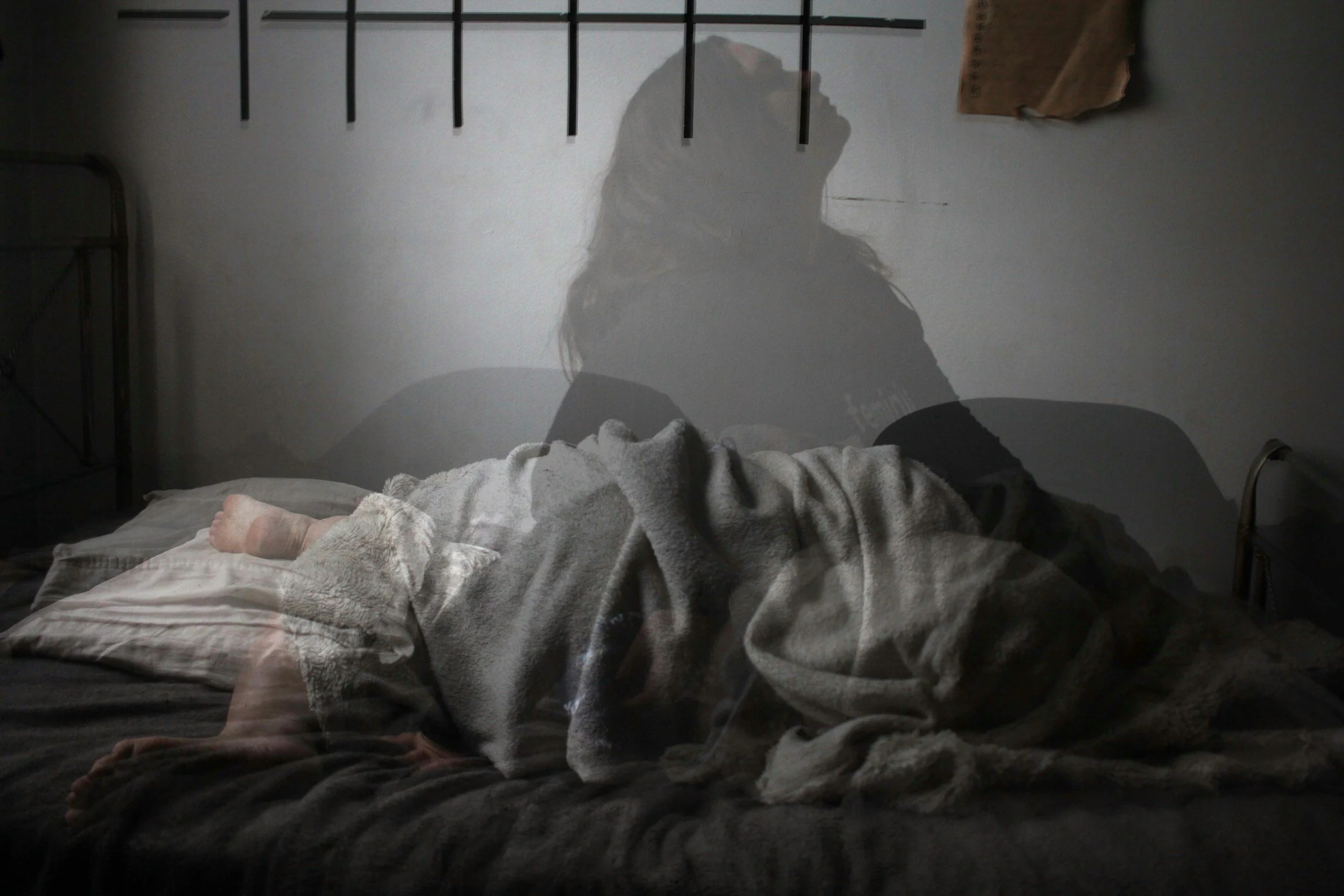
It's 3am. You're wide awake, heart hammering, mind already cycling through tomorrow's to-do list — or last year's argument — or a worry you can't quite name but absolutely cannot shake. Perimenopause night anxiety is one of the most isolating symptoms women describe in my therapy room. You fell asleep fine. You did everything right. And yet here you are, staring at the ceiling.
This post is specifically for two experiences: the woman whose body jolts her awake — heart pounding, breathless, flooded with dread — and the woman whose mind simply switches on in the dark and will not switch off. Both are real. Both have explanations. Both respond to the right kind of support.
If you’d like to get a bigger picture of how mental health fits into perimenopause, check out my Definitive Guide to Perimenopause and Mental Health.
Why Does My Heart Pound When I Wake Up at Night?
That moment of waking with your heart hammering is genuinely frightening. Many women describe it as a visceral sense of danger - even when they're safe in their own beds, with nothing actually wrong. If you've lain there wondering whether something is seriously wrong with your heart, you are not being dramatic.
What you're most likely experiencing is a cortisol surge - a spike in your stress hormone that naturally peaks in the early morning hours as part of your body's wake cycle. In perimenopause, declining estrogen disrupts the careful regulation of this surge, meaning it can hit harder, earlier, and more intensely than it used to.
Progesterone — which has GABA-like calming effects on the nervous system — also falls during perimenopause, removing the natural buffer that once eased you through the night.
Hot flashes can produce the same feeling: a sudden rise in core body temperature activates the sympathetic nervous system, producing that adrenaline-flooded, heart-racing waking.
Your body is correctly reading these physiological cues as "emergency," not knowing it's the systems that regulate your cortisol and temperature that are out of whack.
Understanding that this is a physiological event — not a cardiac crisis, not a panic attack spiralling out of control — can itself begin to reduce the fear response. In therapy, somatic and parts-based approaches help you recognize the body's alarm signal without being swept away by it, building a relationship with that activated state rather than fighting it.
Speaking with your GP or a menopause specialist about hormone support is also worth exploring alongside psychological support.
Why Does My Brain Switch On with Worries at 3am?
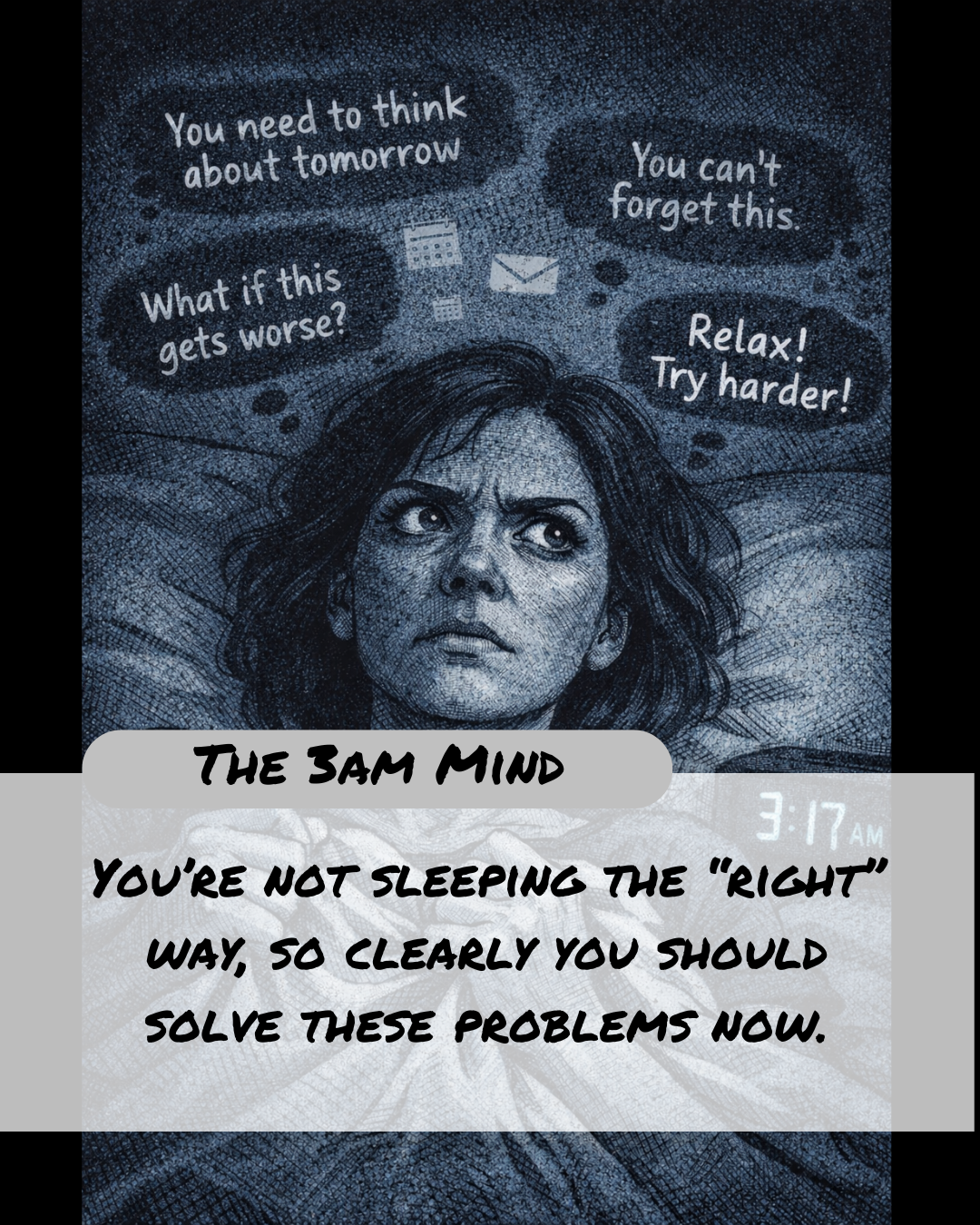
There is something particularly cruel about the 3am mind. You can hold everything together all day — managing work, relationships, the relentless cognitive load of midlife — and then the moment you surface from sleep, it floods in. The worries feel urgent, real, and utterly impossible to dismiss.
Perimenopause changes the structure of sleep itself: hormonal fluctuations shift the balance toward lighter stages where even small disturbances, internal or external, are enough to bring you fully awake. Hormonal changes also make the amygdala more reactive and the prefrontal cortex less effective at calming it down. This is why 3am thoughts feel so catastrophic: your brain is struggling to ignore them and proportion them at that moment.
CBT offers specific, tested techniques for nighttime worry: scheduled worry time, cognitive restructuring, and CBT-I protocols (Cognitive Behavioural Therapy for Insomnia) that directly target the hyperarousal cycle keeping you awake. A therapist working in this framework helps you identify your specific worry patterns and build targeted responses.
Is This Anxiety, or Is It Just Hormones?
This is one of the questions I hear most often — and it matters, because how you answer it shapes whether you seek support or simply wait for it to pass. If you've been wondering whether what you're experiencing is "real" anxiety or a hormonal blip you just have to endure, I want to be clear: the distinction is less clean than it sounds.
Estrogen and progesterone directly influence the brain systems involved in anxiety regulation. Estrogen modulates serotonin and GABA receptors; progesterone metabolizes into allopregnanolone, a naturally calming neurosteroid. When estrogen and progesterone decline — unevenly, unpredictably, across years rather than weeks — the anxiety system becomes dysregulated.
But the hormonal changes don't create anxiety in isolation: they interact with your existing stress load, your nervous system's learned responses, accumulated sleep debt, and your personal relationship with uncertainty.
What we have is biology creating the conditions, and psychology and life context determining how those conditions manifest and how severe they feel.
An integrative approach to therapy works across all of these layers simultaneously rather than treating them as separate problems. If you're uncertain whether HRT, therapy, or both are right for you, a useful starting point is speaking with both a menopause-informed GP and a therapist who understands the perimenopause landscape.
Why Does Everything Feel More Intense at Night?
The darkness has a way of stripping away the context that makes hard things manageable during the day. A worry that feels containable at 2pm can feel catastrophic at 2am.
When external sensory input drops at night, the brain's internal noise — your thoughts, your fears, your unprocessed feelings — becomes disproportionately loud. The absence of distraction gives rumination room to expand.
Midlife brings accumulated losses, shifting identities, and unresolved stresses that surface most clearly when the busyness of the day finally stops. When your brain lacks distraction, it finds the heaviness to ruminate on.
Mindfulness-Based Cognitive Therapy (MBCT) is specifically designed to interrupt this amplification cycle — not by suppressing the thoughts, but by changing your relationship to them. MBCT teaches a skill called decentring: the ability to observe your thoughts as passing mental events rather than getting pulled into them as though they are facts or commands.
Instead of being encompassed by the 3am thought, you learn to notice it — to see it moving through awareness rather than filling it. Practising decentring consistently during the day builds the capacity to use it at 3am, when your brain is insisting that everything is ruined.
Lack of sleep can also intensify daytime emotions; I describe that phenomenon in Menopause, Sleep, & Mood.
What Can Help When My Body Jolts Me Awake?
When you're woken by a pounding heart, tight chest, and heat flooding through you, the instinct is to fight it, resist it, or urgently think your way out of it. That impulse makes complete sense. And it's one of the most important things to understand about the body's alarm system: struggle intensifies it.
What's happening is your sympathetic nervous system activating at the wrong time and with disproportionate force. The thinking brain is not yet fully available, which is why reasoning your way out rarely works in that moment. What does work is deliberately activating the parasympathetic system — the "rest and digest" response — through the body itself. In a parts-based framework, this waking can also be understood as a frightened part of you responding to perceived threat, and the work is learning to meet that part rather than demand it goes quiet.
Tools that help in the moment:
Extended-exhalation breathing: Making the out-breath longer than the in-breath activates the vagus nerve and begins down-regulating the stress response within minutes. Try inhaling for 4 counts, holding for 7, exhaling slowly for 8.
Grounding statement: Pair the breath with something like "my body is responding — this is not my reality right now" to begin separating the physical sensation from catastrophic interpretation.
Parts-based check-in: Rather than demanding the anxiety go quiet, gently acknowledge the frightened part — "I notice you. We're safe right now." This is a skill built in therapy over time, not a trick.
These are practices that build efficacy with repetition, not switches that work on first use.
What Can Help When My Mind Won't Stop?
The racing mind at 3am has a particular quality — it feels almost purposeful, even helpful, as though if you could just review everything thoroughly enough, you might finally solve it. If you've laid there trying to stop the thoughts and found the effort only made things worse, that is not a failure of willpower. This is how anxiety works.
It's not the worrying that keeps you awake — it's the war against the worrying. Acceptance and Commitment Therapy (ACT) and CBT approach this from complementary angles, and both offer techniques with a solid evidence base for nighttime anxiety.
Techniques that help:
Cognitive defusion (ACT): Rather than trying to stop thoughts, create distance from them by recognising them as thoughts rather than truths — noticing "I'm having the thought that everything is falling apart" rather than being fused with "everything is falling apart."
Values anchoring (ACT): At 3am, when anxiety pulls toward problem-solving, your value of rest becomes the reference point to return to — not as a rule, but as an anchor.
Worry postponement (CBT): Contain worries to a designated daytime slot. When a worry surfaces at 3am, it gets noted and genuinely deferred — not suppressed.
Stimulus control (CBT-I): If you've been awake for more than 20 minutes, leave the bed until you feel genuinely sleepy. This breaks the association between the bed and hyperarousal — counterintuitive, but one of the most evidence-based interventions available.
A therapist working integratively can help you build these into a personalised protocol rather than applying them in isolation.
Could This Be About More Than Just Perimenopause?
It is a question worth taking seriously — and asking it doesn't mean you are catastrophising. Sometimes perimenopause is the primary driver of nighttime anxiety; sometimes it acts as a trigger that surfaces something that was already there, waiting for the right conditions to make itself known.
Perimenopause is a significant physiological stressor, and significant stressors have a way of reactivating earlier nervous system patterns — anxious responses learned in childhood, unprocessed grief, or a body that has long been in a low-grade state of vigilance without you fully realizing it.
Parts-based therapy considers that the hypervigilance driving your 3am waking may not be new: it may be an older protective part of you, one that learned to stay on guard during a more threatening time in your life, now reactivated by the unpredictability of perimenopause. Addressing these underlying patterns in therapy, rather than managing symptoms alone, tends to produce more durable change than coping strategies alone. For many women, perimenopause is the first moment that makes deeper work feel both necessary and possible.
If your nighttime anxiety feels connected to old patterns, unresolved experiences, or a sense of dread that seems larger than the hormonal picture alone, it is worth exploring this with a therapist who works across both perimenopause and trauma-informed approaches. This is not about diagnosing you — it is about giving your nervous system the full support it has earned.
Can Therapy Actually Help with Perimenopause Night Anxiety?
If you have ever been told that this is "just hormones" and to wait it out, I want to offer a clear, evidence-based answer: yes, therapy helps — and you do not have to simply endure this.
An integrative approach draws on multiple evidence-based frameworks to address perimenopause night anxiety from several angles simultaneously. CBT targets the cognitive distortions and hyperarousal patterns that maintain nighttime waking. ACT builds psychological flexibility and reduces the struggle against anxiety — which reduces its intensity and its hold. Mindfulness-based approaches regulate the nervous system and create observational distance, making thoughts less overwhelming. Parts-based and somatic work addresses the deeper nervous system conditioning that hormonal changes can reactivate.
None of these approaches requires you to “think positively”, suppress what you're feeling, or wait until you feel better to begin. They work with your experience as it is, building capacity from the inside out.
Critically, CBT-I (Cognitive Behavioural Therapy for Insomnia) has a particularly strong evidence base for insomnia and more specifically, menopausal insomnia, with effects that outlast medication. Research is still being done on perimenopausal women.
If you'd like to explore what psychotherapy might offer you, book a free 20-minute consultation here. The first conversation is about understanding where you are — not committing to anything.
Frequently Asked Questions
Is waking with a pounding heart dangerous during perimenopause?
In the vast majority of cases, no — it reflects a cortisol surge or hot flash triggering the sympathetic nervous system, not a cardiac event. That said, if you have any concerns about your heart, ruling this out with your GP is always the right call. Once a medical cause is excluded, the focus can shift to working with the nervous system response itself.
Why is my anxiety always worse at night than during the day?
Because at night your rational brain is less active while your threat-detection system runs at full capacity. The prefrontal cortex — which contextualizes and proportions your thoughts — is still warming up, while the amygdala is fully online. In perimenopause, estrogen decline makes this imbalance more pronounced, which is why 3am thoughts feel catastrophic even when the same thoughts feel manageable in daylight.
Can CBT really help with waking at 3am?
Yes — specifically CBT-I (CBT for Insomnia), which is designed precisely for this. It addresses the hyperarousal cycle, the unhelpful beliefs that develop around sleep (such as "I'll never sleep properly again"), and the behavioural patterns that inadvertently maintain wakefulness. Research shows it produces durable improvement in menopausal insomnia and anxiety.
Should I try HRT or therapy first for perimenopause night anxiety?
For many women, both together produce the most sustained improvement — and neither rules the other out. HRT can stabilize the hormonal fluctuations that fuel physiological night waking; therapy addresses the psychological and nervous system patterns those fluctuations activate. The right starting point depends on your symptoms, medical history, and what feels most accessible — worth discussing with both your GP and a menopause-informed therapist.
How long does perimenopause night anxiety last?
There is no single answer — perimenopause itself can span anywhere from two to ten years, and anxiety symptoms track individual hormonal patterns rather than a fixed timeline. What does shift the trajectory is active support: therapy, lifestyle adjustments, and if appropriate, hormonal treatment. Women who engage with therapeutic support tend to experience meaningful improvement regardless of where they are in the hormonal transition.
You Don't Have to Keep Waking Up Alone in the Dark
Perimenopause night anxiety — whether it wakes your body or your mind — is one of the most under-resourced experiences women face in midlife. It sits at the intersection of biology, psychology, and a life stage that asks a great deal of you. The physiology is real; the distress is real; and the capacity for genuine change is also real.
The approaches covered in this post — CBT, ACT, mindfulness-based therapy, and parts-based work — are not about managing symptoms until this phase passes. They are about building a different relationship with your nervous system, your thoughts, and your body: one that serves you not just through perimenopause but beyond it.
If you're ready to take that first step, reach out here to book a consultation. I work with women navigating perimenopause in a way that takes both the biology and the whole person seriously. For in-person sessions my office is conveniently located in downtown Whitby, ON, and virtual sessions are available across Ontario.
Sources:
The information on this website is for informational purposes only. It is not intended to be a substitute for professional medical advice, diagnosis, or treatment or to replace your relationship with your health care provider. Always seek the advice of your physician or other qualified health provider with any questions you may have regarding a medical condition. Never disregard professional medical advice or delay in seeking it because of something you have read or seen on this site.