Depression or Depletion? Understanding the Emotional Flatness of Perimenopause

Many women in perimenopause describe the same unsettling experience:
“I’m not exactly sad… I just don’t feel much of anything.”
“I’m functioning, but I feel emotionally flat.”
“I miss feeling like myself.”
This emotional flatness can be confusing and even frightening. Some women worry they’re becoming depressed. Others wonder if they’re burned out, unmotivated, or emotionally checked out. Often, it’s hard to tell where one ends and the other begins.
Part of the challenge is that emotional changes in perimenopause don’t always look like classic depression. Many women continue working, caregiving, and showing up — while feeling muted or disconnected inside. At the same time, depression can emerge during this stage, often shaped by hormonal shifts, sleep disruption, and hot flashes.
Understanding the difference matters. Not to label yourself — but to respond with the right kind of support.
This post is part of my broader series on the menopause transition and mental health: The Definitive Guide to Perimenopause and Mental Health
What Emotional Flatness in Perimenopause Often Feels Like
Emotional flatness is less about sadness and more about narrowing.
Women often describe:
a reduced emotional range
diminished interest or pleasure
lower motivation without despair
difficulty feeling excited, moved, or engaged
a sense of “going through the motions”
Importantly, this flatness doesn’t usually come with intense hopelessness or self-loathing. That absence can make it harder to name — and easier to dismiss or push through.
Many women assume they should feel more, try harder, or snap out of it. But flatness is often not a motivation problem. It’s a capacity problem.
Why Perimenopause Can Mute Emotional Range
Hormones play a quiet but powerful role in emotional responsiveness.
Estrogen influences dopamine and serotonin systems involved in motivation, reward, and emotional engagement. As estrogen fluctuates during perimenopause, these systems can become less efficient. Emotional highs may flatten. Pleasure may feel muted. Emotional reactions may feel dulled or delayed.
This doesn’t mean your personality is changing. It means the neurobiological systems that once supported emotional richness are less stable right now.
Layered onto that are real-life demands — work, caregiving, relationships, identity shifts — all occurring during a stage when emotional regulation is already under strain.
Depletion: When the System Is Simply Out of Fuel
One of the most overlooked contributors to emotional flatness in perimenopause is depletion.
Many women enter midlife after years — sometimes decades — of sustained output. Emotional labour. Responsibility. Productivity. Care for others. Often with limited recovery.
Add to that:
chronic sleep disruption
nighttime anxiety or hot flashes
cognitive load and decision fatigue
hormonal instability
And the nervous system may respond by conserving energy.
Flatness, in this context, can be protective. When resources are low, the system narrows emotional range to prevent overload. This isn’t pathology — it’s adaptation.
The Role of Sleep and Exhaustion
Sleep disruption is one of the strongest drivers of emotional flatness in perimenopause.
Fragmented or non-restorative sleep reduces emotional bandwidth. It dampens both positive and negative emotion. Over time, the brain prioritizes basic functioning over emotional richness.
Many women notice that after prolonged sleep disruption, they don’t feel deeply sad — they feel less. Less reactive. Less engaged. Less available emotionally.
Chronic sleep disruption plays a powerful role in emotional health during perimenopause; for a deeper dive: Menopause, Sleep, and Mood: How Exhaustion Changes Everything
Emotional Flatness vs. Depression: Why the Difference Matters
It’s understandable to wonder whether emotional flatness means depression — and sometimes it does. But often, what women experience in perimenopause doesn’t fully match major depression.
Here’s a simplified way to think about the difference:
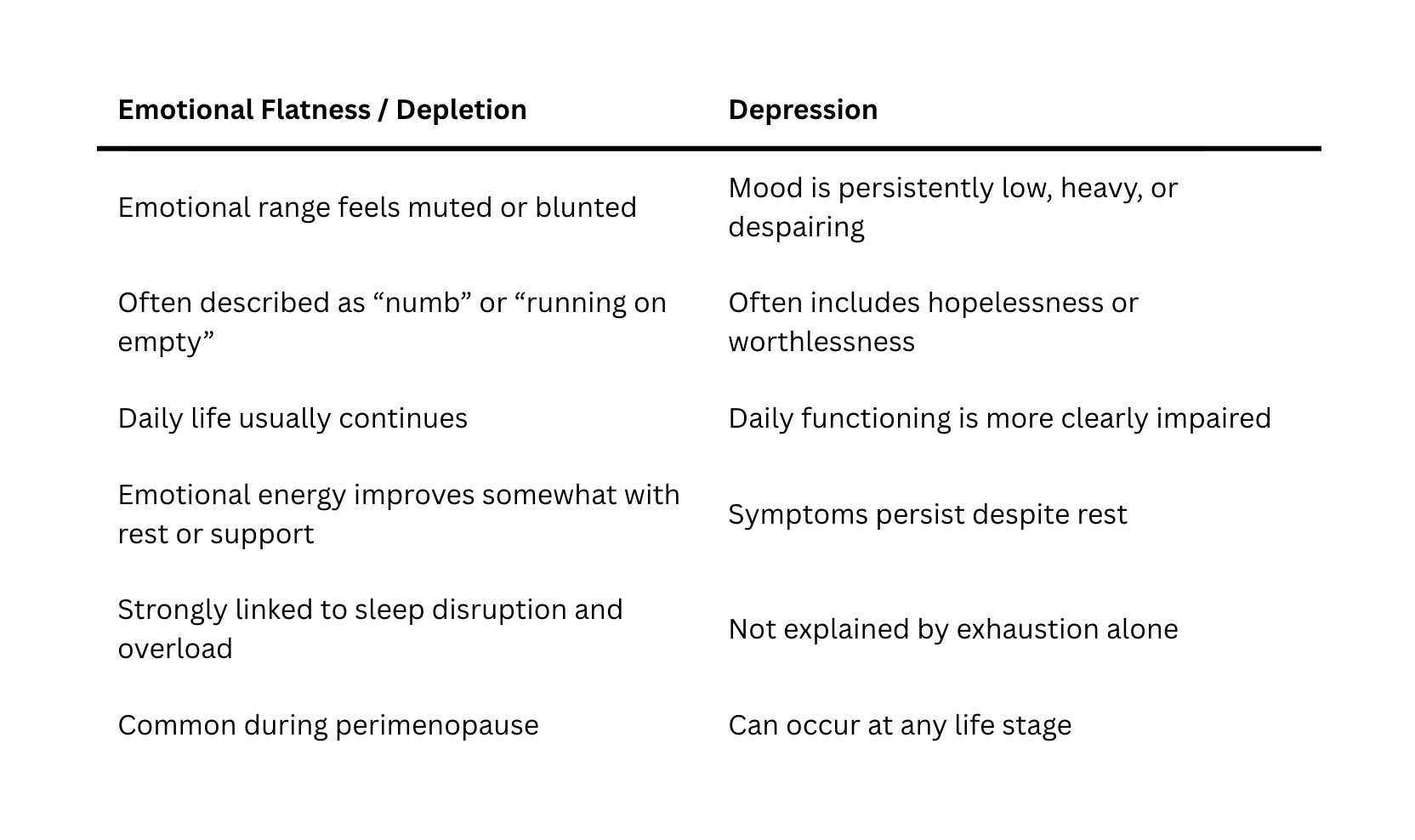
Menopausal depression often looks different from classic depression. Many women continue functioning outwardly while feeling flat or disconnected internally. This can delay recognition and support.
It’s also important to note that depression during perimenopause is strongly linked with hot flashes and sleep disruption, suggesting that hormonal instability and chronic sleep loss play a meaningful role in mood changes during this stage.
And these experiences can overlap. Flatness and depression are not mutually exclusive — and neither should be minimized.
If your flatness feels less like sadness and more like nothing feels enjoyable, you might relate to this piece: The “Blankness” No One Talks About: Anhedonia in Perimenopause.
When to Be Curious (Not Alarmed)
Emotional flatness doesn’t automatically signal depression. But it’s worth paying attention if:
flatness has been present for months without relief
it’s paired with hopelessness, worthlessness, or persistent self-criticism
sleep disruption and hot flashes are worsening
relationships or daily functioning are suffering
rest doesn’t improve it at all
This isn’t about thresholds or diagnoses. It’s about noticing patterns and responding with care.
Why Pushing for Joy Often Backfires
One of the most common mistakes women make when they feel flat is trying to force themselves to feel better.
Pressure — to be grateful, motivated, inspired, productive — often deepens emotional shutdown. Depleted systems don’t respond to effort. They respond to support.
Flatness doesn’t need fixing. It needs space, restoration, and understanding.
Many women ask whether what they’re experiencing is anxiety, depression, or hormonal change. I look more closely at this in: Is This Anxiety, Depression, or Hormones?
What Actually Helps (At the Right Pace)
What supports emotional flatness depends on what’s driving it.
For some women, protecting sleep, reducing output, and addressing depletion allows emotional range to return gradually. For others, therapy focused on meaning, identity, and nervous system restoration helps rebuild connection.
When depressive symptoms are present — especially persistent low mood, hopelessness, or loss of meaning — medical and therapeutic support can be essential.
The goal isn’t to feel “like you used to.”
It’s to feel like yourself again — in a way that fits who you are now.
This Isn’t the End of Your Emotional Life
Emotional flatness in perimenopause can feel like something vital has been lost. But for many women, it reflects a system under strain — not a permanent disappearance of feeling.
Flatness is often a signal to slow down, not a verdict on who you’re becoming.
At the same time, depression during the menopause transition is real and deserves care (from your medical provider). Both things can be true.
With understanding, support, and time, emotional range often returns — sometimes quieter, steadier, and more grounded than before.
Think of perimenopause as a period of change, not erasure.
Some sadness during perimenopause reflects developmental grief rather than depression — more on that here: The Hidden Grief of Perimenopause: Identity, Aging & Letting Go.
If you’d like support in sorting out what’s causing your emotional flatness, I have in-person sessions in Whitby, Ontario, and virtual across Ontario.
The information on this website is for informational purposes only. It is not intended to be a substitute for professional medical advice, diagnosis, or treatment or to replace your relationship with your health care provider. Always seek the advice of your physician or other qualified health provider with any questions you may have regarding a medical condition. Never disregard professional medical advice or delay in seeking it because of something you have read or seen on this site.