I Don’t Feel Like Myself: Is it Perimenopause?
By Kira Hensley, M.A., M.Ed., Registered Psychotherapist | Women's Mental Health, Anxiety & Perimenopause
Updated October 2026. 13 minute read.

You lose the word mid-sentence. You snap at someone you love over nothing, then replay it for hours. You read the same email three times and it still won't land. Somewhere in your 40s, the self you relied on started to feel like a stranger, and no one warned you this was part of it.
The women who look most composed are often the ones struggling the most underneath, and they stay silent because they can't quite name what's wrong. What you're feeling needs explanations from three lanes: your biology, your psychological history, and a social backdrop that left almost all of us unprepared. Once you can see all three, this stops reading as a personal flaw and starts to make sense.
This post focuses on the “losing it” feeling. For a fuller picture of how perimenopause affects mental health, my guide to perimenopause and mental health pulls it pull it all together.
TL;DR: Perimenopause reshapes the brain, reveals old psychological patterns, and lands in of your most demanding life chapter, with almost no cultural preparation. The emotional overwhelm, reactivity, and brain fog you're experiencing are explainable and temporary. Understanding all three layers is what moves women from surviving this transition to navigating it with steadiness.
What is Happening to My Brain in Perimenopause?
Make it stand out
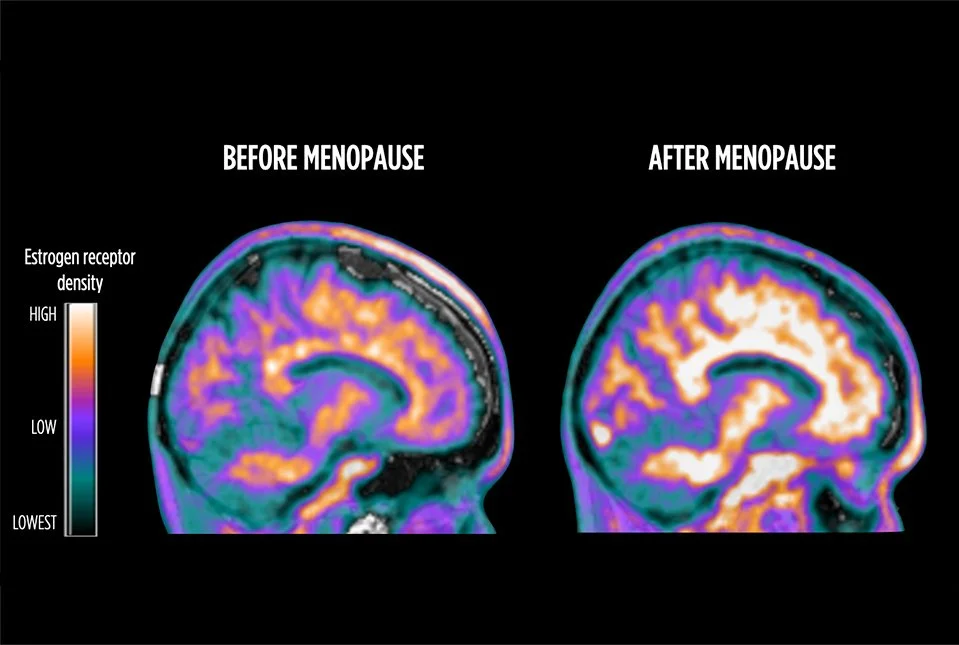
The brain seems to try to compensate for the drop in estrogen over perimenopause by increasing the number of estrogen receptors in the brain.
Scans Show Brain's Estrogen Activity Changes During Menopause. (2024). Retrieved from Weill Cornell Medicine Newsroom.
Your brain is running on a fluctuating, declining estrogen supply, and estrogen helps regulate the regions behind memory, focus, and emotion. As levels swing, so do those functions. That's why words vanish mid-sentence and small things set you off. For most women, it settles as the transition completes.
If you've wondered, in the privacy of your own head, whether this is early dementia, you're far from alone. That fear can weigh more than the symptom that set it off. Something feels wrong in a spot you can't quite point to, and the brain you counted on now drops words and flares at things that never used to register.
The reason sits in your hormones. Estrogen does far more than run your cycle. Its receptors cluster in the hippocampus, which files memories, and the prefrontal cortex, which handles focus and planning. It also shapes your supply of dopamine, serotonin, and norepinephrine, the chemistry behind mood and attention. When estrogen swings and drops, all of that wavers with it, which is why verbal memory tends to slip first and why roughly half of women report memory trouble in these years. Progesterone falls too, easing off a calming brake your system leaned on.
In therapy, we find that once you understand the mechanism behind the changes, the catastrophic story (am I losing my mind?!) loosens, and the symptom gets easier to carry. Supporting the brain through movement, protected sleep, and staying connected and mentally engaged is helpful, too. If the changes are severe or keep worsening, a doctor or menopause specialist can rule out other causes and walk through options with you.
Why Can’t I Sleep in Perimenopause?
The transition attacks sleep from several directions at once. Fluctuating estrogen and falling progesterone remove hormones that helped you fall and stay asleep. Night sweats wake you up. Rising stress hormones, an aging body clock, and shifting mood pile on. Poor sleep then amplifies every other symptom.
You lie awake at 3am with your heart going. Or you sleep straight through and still wake up wrecked, running on fumes by mid-afternoon, when the smallest task feels like too much. By now you may dread bedtime, never sure what kind of night is coming. That dread is well earned.
Sleep in perimenopause rarely breaks for a single reason. Several things hit at once:
Estrogen and progesterone, which normally help you fall and stay asleep, are both declining and swinging. Progesterone's calming byproduct, which acts on the brain's anti-anxiety receptors, fades along with it.
Night sweats spike your body temperature and pull you out of deep sleep. The more frequent they are, the more likely insomnia becomes.
Stress hormones rise with age and with broken sleep itself, so a rough night can nudge cortisol higher the next day.
Your internal clock drifts with age and melatonin production tends to fall. Lower estrogen plays a part, though the link is indirect rather than a simple switch.
Conditions that wreck sleep on their own, like sleep apnea and restless legs, grow more common in these years too.
Lost sleep also raises the next day's stress reactivity, which is how one bad night bleeds into a short-fused morning.
Sleep responds well to treatment. CBT for Insomnia, or CBT-I, is the first-line approach, and in pooled trials it outperformed sleep medication for both insomnia and sleep quality. Where night sweats are driving the wakings, medical options including menopause hormone therapy can help, weighed with your doctor against your own risk factors. Treating sleep as a priority rather than an afterthought lifts almost everything downstream.
Is Brain Fog Normal, or Should I be Worried?
For most women, it's a normal part of perimenopause, not a sign of decline. Brain fog is forgetfulness, scattered focus, words that won't surface, and a mind that feels a step slower than before. Shifting estrogen is a major driver, and the fog tends to lift as hormones settle.
The forgotten names. The thought that dissolves halfway through. The meeting where you lose the thread. The sentence you start and can't finish. Focus scatters, problems that used to feel simple turn tangled, and your patience for any of it wears thin. For a woman who has always been the sharp one, this can shake her deeply.
Estradiol helps your nerve cells form connections with each other and supports the chemistry behind focus, mood, and recall. When it swings, that network runs less smoothly, which surfaces as scattered attention, word-finding trouble, and a slower mental gear. Hormones aren't the whole story though. Poor sleep, stress, and low mood all thicken the fog, and worry about your own mind makes retrieval harder still, a loop where the fear of forgetting feeds the forgetting. Around 60 percent of women notice these cognitive changes, and for most they ease as the transition completes.
Understanding that the fog is hormonal and self-limiting takes the emotional charge out of each blank moment, so it stops spiralling into a fear of dementia. Protecting sleep, moving your body, and treating any anxiety or depression underneath all sharpen things over time. If the changes are severe, one-directional, or worsening, see your doctor or a menopause specialist, who can assess properly and talk through options, including whether hormone therapy fits your wider symptom picture
Why am I so Overwhelmed in Perimenopause?

Your Load Is the Heaviest It’s Ever Been
Perimenopause cuts your reserves at the exact moment that life asks the most of you. Career, kids, aging parents, a share of the household that never got balanced. You ran on this for years with hormonal support. Now that support is fading, and the same demands start to feel impossible.
You are the one who remembers the dentist appointments, the field-trip forms, whose prescription needs refilling, whose birthday is coming up. You've carried all of it - because you could. Lately the same responsibilities feel like too much, and the guilt of not keeping up the way you used to piles on top of that.
Perimenopause tends to arrive in your 40s and early 50s, the same stretch when careers peak and caregiving pulls in both directions, toward growing kids and aging parents at once. The distribution of household and emotional labour rarely shifts to match a woman's falling capacity. The demands don't ease, and eventually the strain shows. What gets read as "not coping" is, more often, a reasonable response to a load that was never sustainable to begin with.
Mindfulness-based work helps here, building the pause between mounting pressure and the moment it tips into shutdown, so you get some choice back in how you respond. That inner work goes further alongside outer change: the conversations about redistributing the load, with a partner, family, or employer, that tend to get deferred for years. Therapy can help you map where the weight really sits, trace the assumptions holding it in place, and name what needs to change.
Why Are Old Wounds Coming Back Up Now?
You no longer have the reserves to keep them buried. For years, staying busy, overfunctioning, perfectionism, or people pleasing kept painful parts at a distance. Perimenopause drains that capacity: as estrogen and progesterone drop, so does the energy those coping strategies required. What you managed to hold down for decades, surfaces.
You did the work. You dealt with the hard things, or you built a life solid enough to hold them at a distance. So it makes little sense that grief, anger, or memories you thought were long behind you are suddenly loud again, showing up without invitation and without an obvious trigger.
In parts-based therapy, sometimes called Internal Family Systems, we think of the mind as made up of parts, including the protectors that formed early to help you cope. One learned to stay strong. Another to keep busy, or to put everyone else first, or to make everything “perfect”. These strategies did their job for a long time. They also run on energy and steadiness your hormones once helped supply. As estrogen and progesterone fluctuate and fall, that steadiness thins and the protectors grow tired. When they can no longer hold the line, the feelings and memories they were guarding start to surface.
This turns out to be an opening in therapy for most women in midlife. Parts-based therapy turns toward what surfaces with curiosity, getting to know the protector, understanding what it was shielding you from, and helping it update to the resources you have now. This often becomes the moment you finally tend to what those parts had been hiding for years.
Why Does No One Talk About Perimenopause?
The women in previous generations were taught to keep perimenopause to themselves, and the ones behind us aren't here yet. That leaves you sensing a major shift with almost no map, and no language for it. Gen X is finally breaking the silence.
If you arrived here blindsided, with no warning about what perimenopause would do to your body and mind, you're in the majority. No one sat you down. There was no talk, no pamphlet, no older woman who said, this is coming and here's what it's like.
I'm in perimenopause myself, so I know this gap from the inside. The generation ahead of us lived through it in silence; the script of their time said you didn't discuss it. The generation behind us is years away and understandably looking elsewhere. That leaves women in midlife oddly alone with it, aware that something significant is happening and unsure who to talk to. Gen X, though, has never been especially good at silent compliance, and we're changing this, naming perimenopause plainly and out loud in a way that's reaching women faster than anything before.
Naming what's happening does more than let off steam. There's good evidence that putting a feeling into words lowers its emotional charge, which is part of why saying "this is perimenopause" can steady you on its own. Finding others who are in it, through honest conversation, community, or therapy, chips away at the shame and isolation that make this stretch harder than it needs to be.
Why Am I So Angry in Perimenopause?
Nothing is wrong with you. The hormones that once padded the space between a trigger and your response are dropping, so the fuse burns shorter. Add broken sleep and years of carrying too much, and the size of the reaction makes sense. The anger is information.
Rage is the symptom women apologize for most. You snap at someone you love over something small, then lie awake ashamed at how big the reaction was. Somewhere in there, a creeping fear sets in. Have you become someone harsh, someone you don't even recognize?
Here's what's behind it. Before perimenopause, estrogen and progesterone kept a buffer between a trigger and a full reaction, widening the gap enough that you could catch yourself. As those hormones drop and swing, the gap narrows and the fuse burns shorter. This isn't a new, angrier you. It's the same you with less of the hormonal cushioning that used to absorb the hit. Broken sleep sharpens the edge further, and so do years of carrying too much with too little help.
Acceptance and Commitment Therapy, or ACT, offers practical tools here. Its defusion techniques create a bit of space between the spark of a reaction and what you do with it, without asking you to swallow the feeling or argue yourself out of it. Understanding what your nervous system is actually managing is what starts to settle it. If you want to go deeper on the anger itself, and what it might be telling you, my post on perimenopause rage picks up there.
What Helps With Perimenopause Overwhelm?
More than you expect, and rarely by doing it alone. An integrative approach, drawing on Cognitive Beahviour Therapy (CBT), ACT, parts-based work, and mindfulness, meets the different layers of what you're feeling. Paired with good medical care, including hormone therapy where it fits, it builds real capacity for this stretch.
By the time most women reach out, they've already tried pushing through, scaling back, and waiting for it to pass. The delay makes sense. When you've always been the capable one, asking for support can feel like conceding something about yourself.
Perimenopause works on several layers at once, so effective help usually does too. An integrative approach lets the therapy meet whatever is loudest for you:
CBT works on the thoughts: the catastrophic reading of a symptom, the shame story that says you're failing.
With ACT, the focus shifts to your relationship with the hard feelings, and to what you want to move toward while they're present.
Parts-based work is for the old protectors surfacing now, helping them update to the life you have today.
Mindfulness trains the pause, that half-second before a reaction where some choice lives.
Therapy also works best alongside good medical care. For some women, especially where depression is part of the picture, hormone therapy and antidepressants are necessary parts of treatment, and a perimenopause-informed therapist will help you see where medical input fits.
If you want to understand the physical side more deeply first, how perimenopause changes your brain is worth reading alongside this. And when you're ready for support, a free consultation is a low-pressure place to start, one conversation to see whether this kind of work fits where you are right now.
Frequently Asked Questions
Is the anxiety I'm feeling in my 40s really perimenopause?
It may well be. Perimenopause lowers your threshold for anxiety: progesterone, which helps calm the nervous system, is dropping, and estrogen's swings add to the reactivity. If the anxiety is new, or sharper than anything you've known before, the hormonal timing is worth considering, even when your periods still seem regular. My post on perimenopausal anxiety versus general anxiety breaks down how to tell them apart.
How long does perimenopause last?
Typically four to ten years, often starting in the early to mid-40s, though some women notice changes sooner. The intensity doesn't climb in a straight line. You can have an easier stretch and assume it's behind you, then find yourself back in it. That unpredictability is part of why the whole thing feels so disorienting.
Is perimenopause rage normal, and will it pass?
Yes, it's common, and for most women it eases as hormones stabilize. Rage tends to blindside women more than sadness or worry, which is part of why it carries so much shame. As the hormonal buffer between a trigger and your reaction thins, less holds the response back, and poor sleep sharpens it further. It's treatable, so it isn't something you simply have to endure.
Can therapy help with perimenopause, or do I need medication?
Both can help, and often the two together work best. Therapy takes on the psychological layer: the catastrophic thoughts, the reactivity, the old patterns resurfacing now. Medical care, including menopause hormone therapy, treats physical drivers like vasomotor symptoms and disrupted sleep. Where depression is part of the picture, both hormone therapy and antidepressants can be a necessary part of care.
Will I feel like myself again?
Most women do, though "yourself" may look a little different on the other side. The cognitive and emotional symptoms tend to settle as the transition completes. What I hear most from clients, looking back, is that they feel steadier than before, partly because the work they did in this stretch, in therapy and in honest conversations, left them more grounded than they'd been in years.
The Bigger Picture
Here's what matters most. What you're going through has a name and a mechanism. The biology is a powerful driver, from the brain changes to the broken sleep. The psychology matters too: the old patterns that surface as your reserves thin. The social reality is its own weight, a full load carried through a transition no one named for you. Seen together, these layers turn "I'm losing it" into something that makes sense, and something you can work with.
You don't have to sort out which layer is which on your own. That's the work I do with women every day.
If something in this post resonated with you, I'd love to help you explore it further. I'm Kira Hensley, a Registered Psychotherapist based in Whitby, Ontario, specializing in women's mental health, anxiety, and perimenopause. I offer in-person sessions at my Whitby practice for women in Durham Region, and virtual sessions for women across Ontario. Book a free consultation here.
The information on this website is for informational purposes only. It is not intended to be a substitute for professional medical advice, diagnosis, or treatment or to replace your relationship with your health care provider. Always seek the advice of your physician or other qualified health provider with any questions you may have regarding a medical condition. Never disregard professional medical advice or delay in seeking it because of something you have read or seen on this site.